

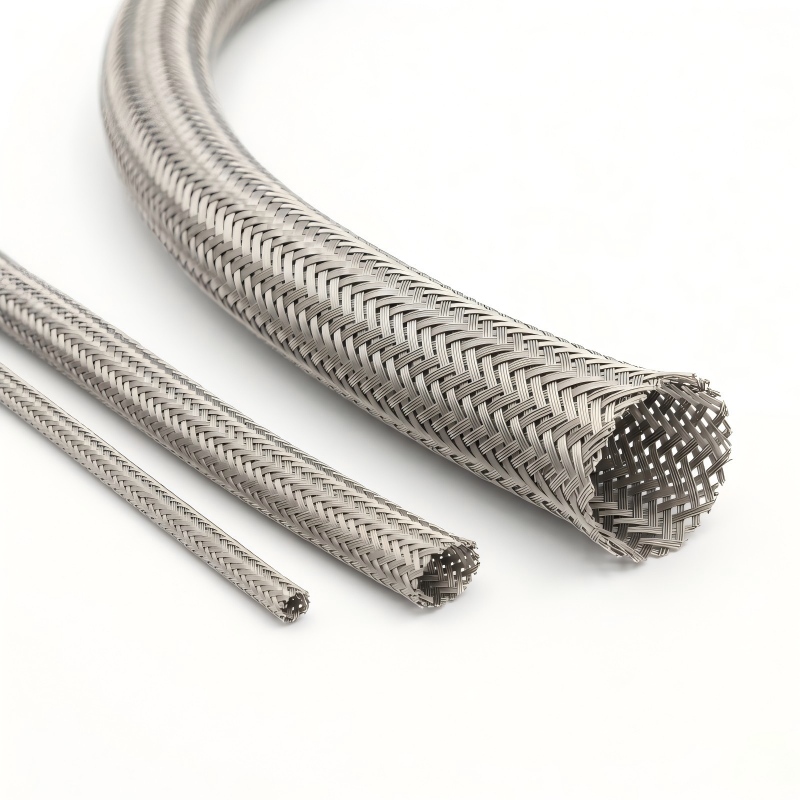
EMI Braided Shielding Sleeve
1. Product Overview
EMI Braided Shielding Sleeve is available in Light-Duty, High-Density Light-Duty, Standard-Duty, and Ultra-Flexible grades. Precision-braided from tinned-copper, silver-plated copper, or nickel-plated copper wires, it delivers EMI shielding and mechanical protection for cable harnesses. With excellent flexibility, expandability, and low transfer impedance, it is lighter than rigid metal shielding tubes. It withstands extreme conditions, including wide temperature range, vibration, repeated bending, salt-spray, and gamma radiation. Widely used in airborne, shipboard, nuclear-power, railway transit, and high-end industrial electronics.
Compliance Standard: Q/320831YHB011-2008
2. Model Reference
Model | Full Description | Material |
TZXP | Tinned-Copper Braided Shielding Sleeve | Tinned copper |
TZYP | Silver-Plated Copper Braided Shielding Sleeve | Silver-plated copper |
TZNP | Nickel-Plated Copper Braided Shielding Sleeve | Nickel-plated copper |
QXTZXP | Reinforced Tinned-Copper Braided Sleeve | Tinned copper |
QXTZNXP | Nickel & Tinned-Copper Composite Braided Sleeve | Nickel-plated + tinned copper |
3. Typical Applications
Airborne harness shielding, ship & locomotive wiring, nuclear-radiation zone cable protection, high-temperature precision instrument cables, aerospace & industrial-control signal harnesses.
4. Key Technical Specifications
Parameter Category | Specifications |
Temperature Range | -65℃ ~ 180℃ continuous; 200℃ short-term peak |
Shielding & Electrical | Braiding coverage 70%–93% customizable |
Mechanical | Expandable structure; Abrasion > 10,000 cycles; Min. bend radius: 3 × nominal ID; Cut-resistant against fraying on-site |
Material & Size | Tinned / silver-plated / nickel-plated copper wire; single wire: 0.08–0.26 mm; Inner diameter: 1–60 mm; 4 grades optional |
Flame & Environment | UL94 self-extinguishing, halogen-free low-smoke, RoHS compliant, meets EN45545-2 railway fire-safety |
Environmental Resistance | Resistant to seawater, acid-alkali, gamma radiation, salt-spray, humidity, and vibration |
5. Grade Features
Standard-Duty: Cost-effective, 70–80% coverage, for general harnesses
Light‑Duty: Weight-saving design, 80–85% coverage, for weight-critical projects
High-Density Light-Duty: ≥93% coverage, balances low weight and superior shielding
Ultra-Flexible: Excellent cyclic bending performance for moving harnesses; ≥85% coverage
Reinforced QXTZXP/QXTZNXP: Heavy-duty braiding for large sizes up to 60 mm ID
6. Manufacturing Advantages
High-precision multi-spindle braiding ensures consistent weave density. Customizable inner diameter, plating material, and braiding coverage. No weave loosening under expansion or bending. Supports field cutting; compatible with crimping, soldering, and conductive‑bond termination. Standard reel length: 100 m; sizes over 40 mm: 50 m standard.
FAQ
Q1: What are the advantages of braided shielding sleeves compared with rigid metal shielding tubes?
A: Excellent flexibility and expandability for complex routing; Significant weight reduction; Easy on‑site installation and harness retrofitting; Reliable shielding performance under cyclic bending; Ultra‑flex versions fit continuously moving cables.
Q2: How to select proper braiding coverage?
A: 70‑80% for general‑purpose low‑frequency power harnesses; 85% for common industrial and aerospace signal wiring; 93% high‑density grade for heavy EMI interference and high‑frequency applications. Higher coverage brings better shielding performance with increased weight and cost.
Q3: How to choose between tinned‑copper, silver‑plated copper and nickel‑plated copper sleeves?
A: Tinned‑copper provides cost‑effective shielding for power and low‑frequency signal cables. Silver‑plated copper features lower high‑frequency impedance and anti‑tarnishing performance for aerospace high‑precision high‑frequency circuits. Nickel‑plated copper excels in high‑temperature oxidation resistance for long‑term hot‑environment operation.
Procurement Inquiry Instructions
Please inform our team of your operating-temperature requirements, radiation or water-immersion working conditions, part number, conductor specifications, and purchase quantity. We will supply engineering drawings, product samples, and accurate quotations accordingly.