

5 Critical Pitfalls to Avoid When Sourcing Mil‑Spec and Aerospace Wires Globally
If your team is sourcing mil‑spec and aerospace wires from overseas suppliers, one bad decision can derail your whole project timeline. Many procurement managers underestimate hidden risks before confirming orders for mil‑spec and aerospace wires. Price is never the only benchmark to judge reliable manufacturers of mil‑spec and aerospace wires. You need to dig far deeper than quoted unit costs.
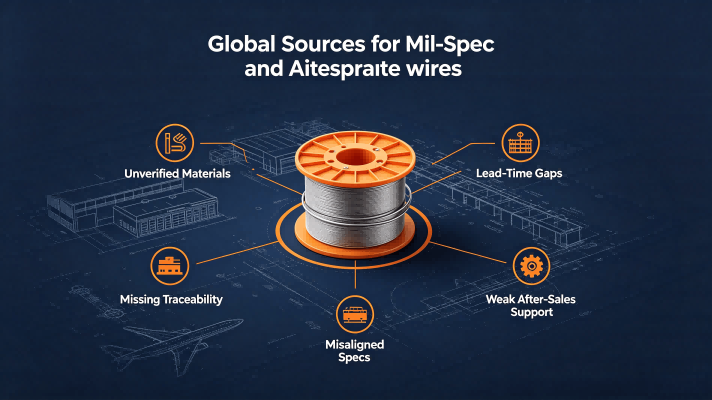
1. Unverified material compliance tops our risk checklist
Some factories claim they can produce mil‑spec and aerospace wires, yet skip third‑party material testing. Insulation polymers like PFA, FEP or polyimide must meet exact military and aerospace standards. Sub‑standard raw materials will make your finished mil‑spec and aerospace wires fail harsh vibration, temperature or fire‑resistance tests. Re‑work costs and delivery delays follow fast.
2. Delivery lead‑time gaps are another common trap
Plenty of cable suppliers promise fast shipment for mil‑spec and aerospace wires. They hide long certification turnaround periods from your quotation. Mil‑spec and aerospace wires require batch documentation, inspection reports and traceability records before dispatch. Without a clear milestone schedule signed by both sides, you risk costly production shutdowns back at your facility.
3. Do not overlook traceability documentation
Every batch of mil‑spec and aerospace wires needs full, auditable records. Some offshore manufacturers deliver finished cables with incomplete test certificates. Missing material lot numbers or heat‑treatment logs invalidate the qualification of your mil‑spec and aerospace wires for aerospace projects. Audits from your end‑client will get rejected immediately.
4. Miscommunication on custom specifications wastes thousands of procurement budgets
Mil‑spec and aerospace wires often carry unique requirements: conductor stranding, insulation wall thickness, shielding structure, colour‑coding or special marking. Verbal agreements or loose email descriptions leave too much room for interpretation. Even tiny dimensional deviations render your mil‑spec and aerospace wires unusable for high‑end defence or airborne applications.
5. Ignore long‑term after‑sales support at your own risk
Sourcing mil‑spec and aerospace wires is not a one‑off transaction. You may need supplementary test data, replacement batches or engineering consultation months after delivery. A supplier that only chases new orders will disappear once payment clears. Build partnerships with manufacturers ready to back your mil‑spec and aerospace wires through the full product lifecycle.
FAQs
Q: What is the biggest hidden risk when buying mil-spec and aerospace wires overseas?
A: Unverified material compliance and incomplete traceability are the top risks. Many suppliers cut corners on raw material testing to lower prices. These substandard mil-spec and aerospace wires look qualified but fail strict military and aerospace performance tests, causing project failures.
Q: How do I quickly confirm a supplier’s mil-spec and aerospace wires are fully compliant?
A: Check complete batch documents directly. Reliable mil-spec and aerospace wires come with matched test reports, lot records and valid certifications. No full paperwork means the mil-spec and aerospace wires have unexposed compliance risks.
Q: Why do mil-spec and aerospace wires often face delivery delays?
A: Most delays come from hidden certification and audit procedures. Unlike regular cables, mil-spec and aerospace wires need strict batch verification and document filing before shipment. Many suppliers omit this process in quotations, leading to unexpected delays.
Q: Can I accept tiny spec deviations for mil-spec and aerospace wires?
A: No. Every parameter of mil-spec and aerospace wires serves extreme aerospace and military working conditions. Even minor deviations ruin stability and safety. Always confirm custom specs in writing and with pre-production samples.